The word charcuterie (the art of preparing and preserving meat, especially pork) derives from chair cuite (cooked flesh), and for centuries the charcutier (pork butcher and preparer of cured meats) occupied a central role in French food life. Before refrigeration, before supermarkets, before vacuum packing, the charcutier was the person who ensured that meat — above all pork — lasted through the winter. Salting, smoking, curing, confiting, potting, encasing in fat: these were not culinary flourishes but survival technologies, and the French refined them into an art that no other country has matched.
Walk into any charcuterie (shop selling prepared meats) in France today and you will find the evidence hanging from the ceiling and filling the glass cases. Saucissons dangle in clusters, their white mould casings speaking of months of patient drying. Terrines and pâtés line the counter in orderly rows. Rillettes sit in their earthenware pots. Jambon hangs on the bone. The philosophy that drives it all is simple: nothing is wasted. Every part of the animal, from snout to tail, has a purpose, a preparation, and a name.
Saucisson Sec
France's Favourite Snack
Saucisson sec (dry-cured sausage) is the defining product of French charcuterie — a dry-cured sausage made from coarsely chopped pork (and sometimes pork fat, sometimes a blend with other meats), seasoned with salt, pepper, and garlic, stuffed into a natural casing, and hung to dry for weeks or months. The white bloom on the outside is a natural mould — Penicillium nalgiovense, a close relative of the moulds used in cheese — which protects the sausage during drying and contributes to its flavour.
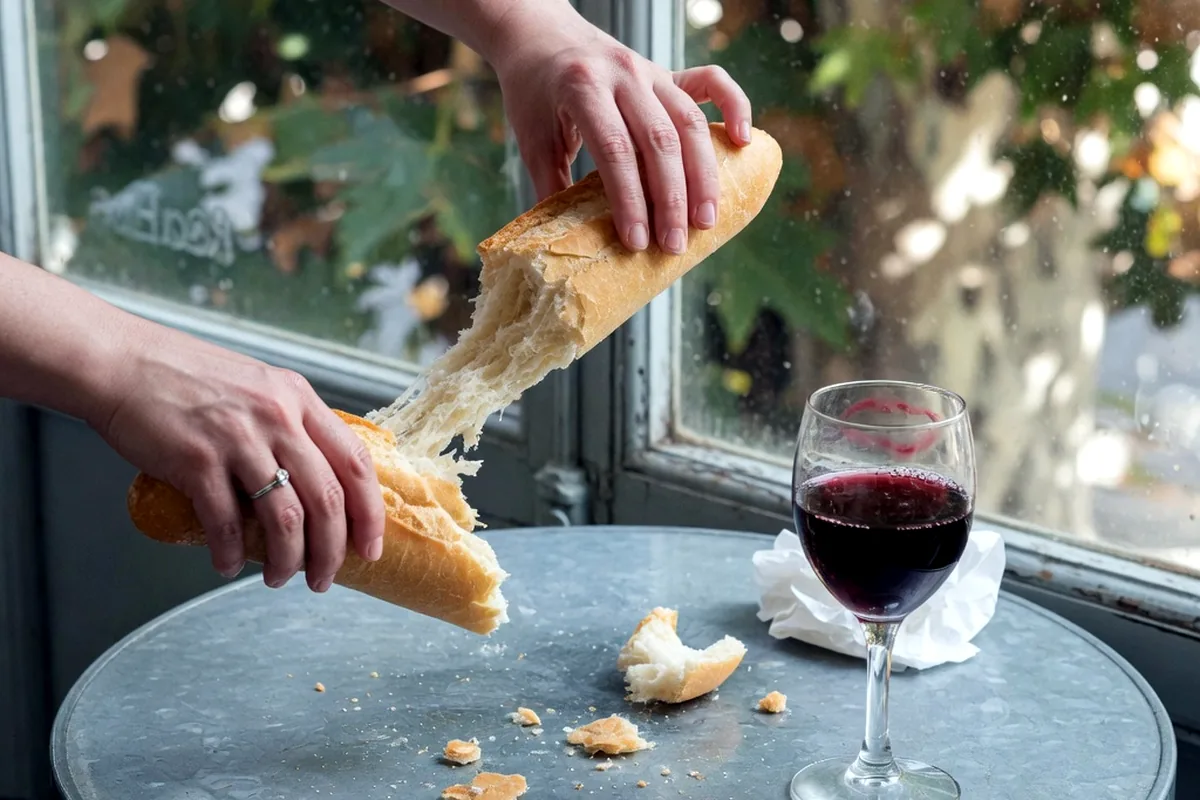
Saucisson is everywhere in France. It sits on every apéritif spread, appears in every market, and fills the luggage of every French person returning from a regional holiday. Slicing it is a meditative act: cut it at a gentle angle, in rounds no thicker than a coin, and eat it with good bread and a glass of red wine. The combination is one of the simplest and most satisfying in all of French gastronomy.
Regional Styles
Rosette de Lyon (large, slow-cured sausage from Lyon) is the queen of saucissons — a large, pear-shaped sausage that takes its name from the rosette casing (the end of the large intestine) and its fame from Lyon, the capital of French charcuterie. A rosette may dry for three to four months, developing a concentrated, deeply savoury flavour.
Jésus de Lyon (very large saucisson from Lyon, named for its size and shape) is even larger, named — depending on whom you ask — for its swaddled appearance resembling a baby in a manger or simply for its traditional association with Christmas. It can weigh over a kilogram and requires up to five months of drying.
The saucisson d'Auvergne (saucisson from the Auvergne region) hails from the volcanic highlands, where cold mountain air and specific breeds of pig produce a drier, more intensely flavoured product. Variants include saucisson studded with noisettes (hazelnuts), walnuts, blueberries, Roquefort, or Espelette pepper — though purists argue that a truly great saucisson needs nothing more than pork, salt, pepper, and time.
| Saucisson Essentials | Detail |
|---|---|
| Always slice at an angle, no thicker than a coin | |
| The white mould on the outside is natural and desirable — do not remove it | |
| Store unwrapped in a cool, dry place (not the fridge, which inhibits flavour) | |
| Rosette de Lyon and Jésus de Lyon are the prestige saucissons | |
| Saucisson d'Auvergne and saucisson from the Ardèche are prized regional varieties | |
| Look for saucissons labelled pur porc (pure pork) and fabrication artisanale (artisan-made) | |
| A saucisson should feel firm to the touch but not rock-hard — some give indicates proper moisture |

Jambon
The Great Hams of France
Jambon (ham) in France divides into two fundamental categories: jambon cru (raw/cured ham) (dry-cured, air-dried ham, eaten uncooked) and jambon cuit (cooked ham) (wet-brined and cooked, served sliced). Both have their nobility.
Jambon de Bayonne IGP
Jambon de Bayonne (dry-cured ham from the Basque Country, with IGP status) is France's answer to Parma ham and Jamón Ibérico — a dry-cured ham from the Basque Country and surrounding Adour basin that carries Indication Géographique Protégée (Protected Geographical Indication) (IGP) status. The pork must come from designated breeds raised in south-western France; the curing uses salt from the Salies-de-Béarn salt springs; and the aging lasts a minimum of seven months, though twelve to eighteen months produces the most complex results.
The flavour is delicate, sweet, and nutty — milder than Spanish serrano, less intensely savoury than Italian prosciutto, with a clean finish that makes it a superb partner for melon, figs, or simply eaten alone with bread. The annual Foire au Jambon (Ham Fair) in Bayonne, held over Easter weekend, is a celebration of the product and its region.
The Basque Country — Visit Bayonne, Biarritz, and the Pays Basque — where ham, chocolate, and Espelette pepper define the table.
Jambon de Paris
Jambon de Paris (classic cooked ham from Paris, also known as jambon blanc), also called jambon blanc (white ham — cooked, boneless ham), is the cooked ham that fills every French sandwich, wraps every croque-monsieur (toasted ham and cheese sandwich with béchamel), and sits in every brasserie's assiette de charcuterie (charcuterie plate). At its best — pale pink, moist, subtly seasoned, sliced thick — it is a quietly excellent product. At its worst, it is the pallid industrial rectangle found in plastic packages worldwide. The distinction matters. A good charcutier (pork butcher)'s jambon de Paris, cooked on the bone and sliced to order, is an entirely different experience from its supermarket namesake.
Rillettes
The Rivalry of Tours and Le Mans
Rillettes (slow-cooked shredded meat, potted in its own fat) are one of France's most ancient and satisfying preparations — meat (traditionally pork, though duck, goose, rabbit, and even fish versions exist) cooked very slowly in its own fat until it falls apart, then shredded, seasoned, and packed into pots or terrines where the fat rises to form a seal.
The origin of rillettes is claimed by two Loire Valley cities with equal ferocity. Rillettes de Tours (smoother, more spreadable rillettes from Tours) are the more refined version — smoother, more spreadable, paler in colour, with a delicate texture sometimes described as "brown butter for bread." Rillettes du Mans (coarser, more rustic rillettes from Le Mans) (also called rillettes de la Sarthe (rillettes from the Sarthe department), which carry IGP status) are coarser and more rustic, with visible strands of meat and a darker, more caramelised flavour.
Both versions share the same principle: patience. The pork cooks for four to six hours over the gentlest heat, the fat rendering slowly while the meat softens and separates. The result is intensely savoury, rich without being heavy, and a magnificent thing spread thickly on toasted bread with a scattering of cornichons (small, tart pickled gherkins) alongside.
Duck Rillettes
Rillettes de canard (duck rillettes) are especially prized in the south-west, where duck and goose are the foundation of the local charcuterie tradition. Duck rillettes tend to be richer and slightly gamier than pork, with a golden colour from the duck fat. In the Périgord and the Landes, they are a fixture of the apéritif table.
Pâté de Campagne
The pâté de campagne (country-style pâté, coarsely textured) — "country pâté" — is the backbone of the charcutier's art. Every charcuterie shop makes its own version, and no two are exactly alike. The basic architecture is coarsely minced pork (a mix of lean meat and fat back), seasoned with salt, pepper, herbs (thyme and bay are standard), and usually a splash of brandy, packed into a terrine and baked in a bain-marie (water bath used for gentle, even cooking).
The beauty of pâté de campagne lies in its rusticity. It should be rough-textured — this is not a smooth liver mousse — with visible chunks of meat and fat, a crust that forms on top during baking, and a flavour that tastes of the particular charcutier's hand. Some add pistachios; others incorporate chicken liver for richness; some use quatre-épices (French four-spice blend: pepper, nutmeg, cloves, ginger), the classic French spice blend of pepper, nutmeg, cloves, and ginger.
Related Preparations
Pâté en croûte (pâté baked inside a pastry crust) wraps the forcemeat in pastry — a more elaborate production, and one that has enjoyed a spectacular revival in recent years, with the annual Championnat du Monde du Pâté en Croûte in Lyon attracting competitors from around the world. Terrine (a coarsely textured meat preparation baked in an earthenware dish) is, technically, the name of the dish rather than the food, but common usage has made them interchangeable. Galantine (boned, stuffed poultry, poached and served cold) is a more refined cousin — boned poultry, stuffed, poached, and served cold in slices.
Boudin Noir
Boudin noir (black pudding / blood sausage) is France's blood sausage — pig's blood, fat, and onions encased in intestine and cooked until just set. It is ancient, it is divisive, and it is magnificent. The finest boudin noir has a creamy, almost mousse-like texture inside its dark casing, and its traditional accompaniment is sautéed apples — the sweetness of the fruit cutting through the mineral richness of the blood.
The spiritual home of boudin noir is Mortagne-au-Perche (small town in Normandy, home of the blood sausage festival), a small town in Normandy that hosts an annual Foire au Boudin (Blood Sausage Fair) every March. Charcutiers from across France compete to produce the finest boudin, and the winner earns the title of Chevalier du Goûte-Boudin (Knight of the Blood Sausage Tasting) — a distinction worn with genuine pride.
Boudin blanc (white sausage made from chicken, veal, or pork, with cream) is the gentler cousin — a white sausage typically made from chicken or veal, milk, cream, and eggs. It is the traditional Christmas Eve sausage, served with truffles in the most luxurious versions.
Andouillette
The andouillette (tripe sausage, a polarising French speciality) is the most polarising item in all of French charcuterie. Made from pig intestines (and sometimes stomach), cut into strips, seasoned, and re-encased in intestine, the andouillette has an aroma and flavour that can only be described as profoundly, unapologetically intestinal.
French food lovers tend to take a binary position: they adore it or they avoid it entirely. The quality label to seek is the AAAAA — the Association Amicale des Amateurs d'Andouillette Authentique (Friendly Association of Lovers of Authentic Andouillette), a body of five A's that certifies andouillettes meeting their standards of handmade craft and authentic flavour. Troyes, in the Champagne region, claims to make the finest andouillettes in France, though Lyon disputes this with characteristic vigour.
The related andouille (large, cold-smoked tripe sausage from Brittany or Normandy) — note the lack of the diminutive -ette — is a larger, smoked sausage sliced cold. The andouille de Vire (smoked tripe sausage from Vire in Normandy) and andouille de Guéméné (smoked tripe sausage from Guéméné-sur-Scorff in Brittany) are the two great regional styles.
Confit and Duck Products
The South-West Tradition
Confit de canard (duck legs slowly cooked and preserved in their own fat) — duck legs slowly cooked in duck fat until meltingly tender, then stored submerged in that same fat — is one of the great dishes of the French south-west. The technique is pure charcuterie: cooking and preservation in one step, producing a product that can last for months in a cool cellar.
The Périgord, the Landes, the Gers, and the Lot are the heartlands of this tradition, where the duck and goose are as central to the kitchen as the pig is in the rest of France. Products from these regions include:
Gésiers confits (preserved duck or goose gizzards) — duck or goose gizzards, confited until tender, are sliced warm over salad greens for one of the south-west's most iconic bistro dishes. Magret de canard (duck breast from a bird raised for foie gras) — technically the breast of a duck raised for foie gras, distinguished from ordinary duck breast by its thick layer of subcutaneous fat — is grilled like a steak and served pink. Cou de canard farci (stuffed duck neck) — the neck, boned and stuffed with a forcemeat of duck, pork, and foie gras — is a humble-sounding preparation of genuine magnificence.
The Dordogne & Périgord — Discover France's south-western larder — truffles, duck confit, foie gras, and walnut oil in one of Europe's loveliest landscapes.
Regional Charcuterie
Corsica
Corsican charcuterie is a world apart, shaped by the island's chestnut forests and its semi-wild porcu nustrale (Corsican heritage pig breed) pigs. Figatellu (Corsican liver sausage, eaten fresh or dried) is a smoked liver sausage eaten fresh (grilled over chestnut wood) or dried. Lonzu (Corsican dry-cured pork loin) is dry-cured pork loin. Coppa (Corsican dry-cured pork collar) is cured collar. Prisuttu (Corsican dry-cured ham, aged 12-24 months) is Corsican ham, aged twelve to twenty-four months. The chestnut diet of the pigs gives all these products a distinctive nutty sweetness found nowhere else in France.
Alsace
Alsatian charcuterie reflects the region's position between French and Germanic traditions. Knack (Alsatian smoked sausage, similar to a frankfurter) — smoked sausages similar to frankfurters — are served with sauerkraut. Fleischnacka (Alsatian rolled meat and pasta dish) are spirals of meat rolled in pasta dough and sliced. The great Alsatian charcuterie platter, served with choucroute garnie (sauerkraut garnished with assorted sausages and meats), is one of the most generous displays of cured meat in all of France.
Auvergne
The Auvergne is saucisson country. The highland climate — cold, dry winters and cool summers — creates ideal conditions for drying and curing. The salaisons d'Auvergne (salt-cured meats of the Auvergne) include not only saucisson but also dried hams, saucisses sèches (dried sausages), and fritons (rendered pork scratchings from the Auvergne) — crispy, rendered scraps of pork that are essentially French pork scratchings.
| Essential French Charcuterie | Detail |
|---|---|
| Saucisson sec — dry-cured pork sausage, the cornerstone of French charcuterie | |
| Jambon de Bayonne IGP — dry-cured ham from the Basque Country | |
| Rillettes — slow-cooked shredded pork (or duck) potted in its own fat | |
| Pâté de campagne — rustic country pâté, coarsely textured | |
| Boudin noir — blood sausage, traditionally served with apples | |
| Andouillette — tripe sausage, an acquired taste (look for the AAAAA label) | |
| Confit de canard — duck legs preserved in duck fat | |
| Rosette de Lyon — prestige saucisson from Lyon | |
| Figatellu — Corsican smoked liver sausage | |
| Pâté en croûte — pâté baked in a pastry crust, enjoying a major revival | |
| Boudin blanc — white sausage, traditional at Christmas | |
| Cornichons — the essential charcuterie accompaniment (small tart gherkins) |
The Charcuterie Board
Building a Planche
The planche de charcuterie (charcuterie board) is the French answer to the Italian antipasto platter and has become one of the defining food trends of the last decade, though in France it has been standard apéritif fare for centuries. A well-composed planche offers variety in texture, fat content, and flavour intensity.
Start with a saucisson sec, sliced thin. Add three or four slices of jambon cru. Include a generous spoonful of rillettes. Add a slice of pâté de campagne. Scatter cornichons and pickled onions around the edges. Provide good bread — a pain de campagne (country-style bread) or a crusty baguette (long, narrow French bread) — and a pot of moutarde de Dijon (Dijon mustard). That is the framework. The rest is personal taste.
Market Buying Tips
The best charcuterie in France is found at markets, not supermarkets. Look for stalls run by actual charcutiers (charcuterie makers) rather than resellers — they will be the ones who can tell you the breed of pig, the length of drying, the specific seasoning. Taste before buying; any self-respecting market charcutier will offer samples. Buy saucisson whole if you can — it keeps better uncut, and the act of slicing it at home is one of life's small pleasures.
Lyon: France's Gastronomic Capital — No city does charcuterie like Lyon — discover the bouchons, the halles, and the rosettes that made it famous.